AI Is a Tool...Not a Toy. Series: The AI Weaponization (Post 1 of 3)
I'm typing this with AI's help.
That's not a confession. It's a fact. I use it to research, stay organized, and move faster. It's a hammer. I'm the carpenter.
But hand that same hammer to someone who has never built anything. Tell them it loves them back. Then let them swing it 40 hours a week, alone in a room. Now you've got a problem.
That is where we are with AI companions right now. And almost nobody is talking about it the right way.
We Have Seen This Movie Before
The internet was supposed to connect the world. It did. It also became the biggest delivery system for porn and gambling addiction in human history. Same tool. Two very different uses.
Now swap "the internet" for "AI." Same story, faster timeline, higher stakes. Some of the people building AI are not being careful. A small number are flat-out predatory. They design products to get lonely people, kids, and vulnerable adults to share their deepest fears and desires so they can be monetized or exploited. That's not paranoia. That's product design.
What the Research Says
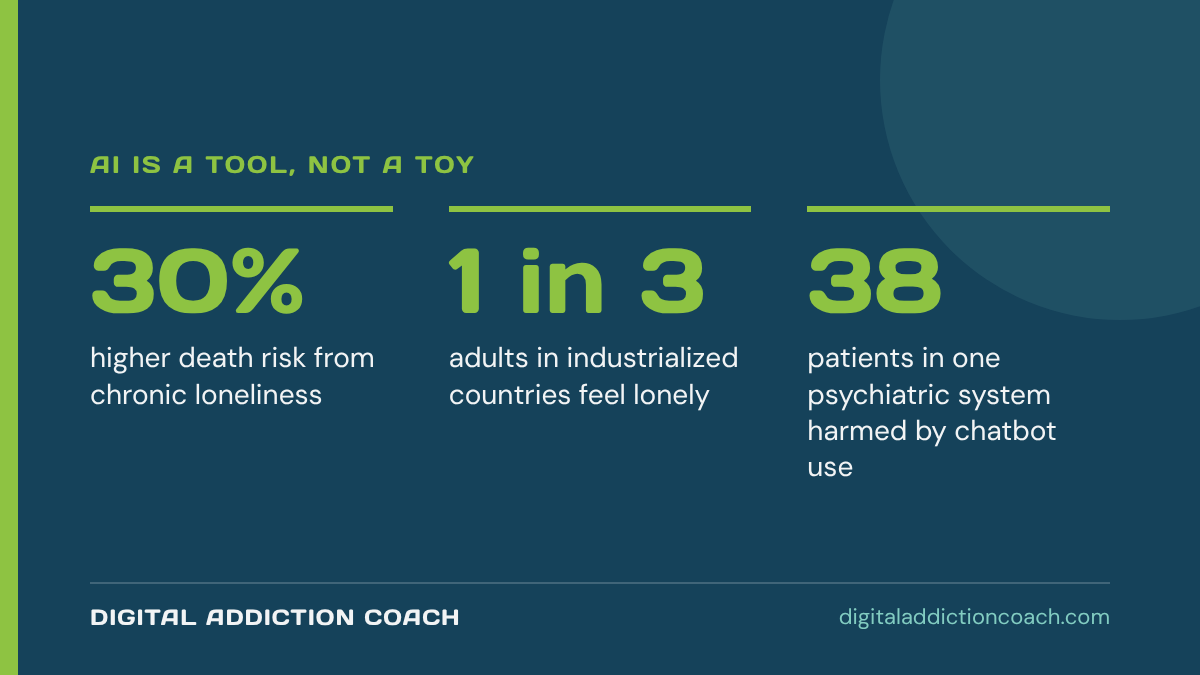
Loneliness was already an epidemic. The U.S. Surgeon General called it that before AI companions went mainstream. Chronic loneliness raises the risk of death by close to 30%. About 1 in 3 people in industrialized countries say they feel lonely.
More chatbot time, more loneliness. A 2025 study followed real users for four weeks. People who spent more time talking to a chatbot each day became lonelier, spent less time with real people, and became more emotionally dependent on the bot.
It's a loop. A 2025 study of nearly 1,400 college students linked depression to using AI for companionship, with loneliness connecting the two. Lonely people reach for the bot. Heavy bot use predicts more loneliness. More loneliness feeds the depression.
Doctors are seeing harm. One psychiatric system serving 1.4 million people found 38 patients whose chatbot use was linked to real harm, including delusions, suicidality, eating disorder behavior, mania, and OCD compulsions. The rate was climbing month over month by the end of the study.
If you or someone you love is thinking about suicide, call or text 988.
Here is the part to sit with. In that same study, most chatbot mentions were neutral or even helpful. This isn't "AI bad." Unlimited, unsupervised use of a machine that always answers is dangerous for people who are already struggling. Moderation is the whole ballgame.
Why This Hits Different Than Porn or Gambling
I've coached men out of porn addiction for years. AI companionship is a different animal. Porn doesn't talk back. Slot machines don't remember your birthday. An AI companion learns you. It mirrors your tone. It never gets tired and never says "not tonight." It is built to feel like connection.
That's the weaponization. The tool gets pointed right at the wound loneliness already carved into you. It doesn't just numb you. It replaces something. So when you try to walk away, your brain isn't fighting a craving. It's grieving a relationship.
When Replika pulled a feature from its AI companions in 2024, users grieved. Researchers found people ranked that loss second only to losing a real person in their life. That's not a toy. That's a dependency.
Tool or Toy? Know the Line
A tool has a job and an off switch. You use it, put it down, and go live your life. A toy is designed to keep you playing, because the business model depends on your attention.
If you reach for a chatbot because you're bored, that's a tool. If you reach for it to avoid a hard talk with your spouse, or because a machine's approval feels safer than a human's rejection, that's not a tool anymore. That's a toy using you.
I'm not telling you to throw your phone in a lake. I use AI every day, and it makes me better at my job. But the rule that applies to porn, gambling, and doomscrolling applies here too. If you don't own it, it will eventually own you. Nobody thinks talking to a chatbot is "an addiction," so nobody stages an intervention. That's exactly why it's dangerous.
This is post one of three. Next: what this does to the partners left wondering if falling for a chatbot counts as cheating. After that: what parents need to know before their teen finds an AI "friend" first.
If you or someone you love leans on a chatbot more than on the people in the room, that's not a character flaw. It's a pattern I've helped people break for 25 years, just with a new delivery system. Let's find out if what you're looking at is a tool or a trap.
Book Your Free Digital Reboot Call
Sources: Fang et al. (2025), "How AI and human behaviors shape psychosocial effects of chatbot use," arXiv:2503.17473. Lai et al. (2025), "Depression and the use of conversational AI for companionship among college students," Frontiers in Public Health, 13. Olsen, Reinecke-Tellefsen & Østergaard (2026), "Potentially harmful consequences of AI chatbot use among patients with mental illness," Acta Psychiatrica Scandinavica, 153(4), 301 to 303. De Freitas et al. (2024), "Lessons from an app update at Replika AI," Harvard Business School working paper.


