
Tell Me Everything or Tell Me Nothing? Neither. Part 2 of 3
Part 2 of 3. For partners and spouses. This series is about supporting a partner through porn recovery. If you missed it, read Part 1 first.
Once a couple decides to stay and rebuild, they usually swing toward one of two extremes.
Trap one: full disclosure, all the time. Every urge. Every close call. It feels like honesty. It's really your partner's anxiety, moved into your lap.
Trap two: total silence. Your partner shuts down and shares nothing. You're left guessing, and the constant watching starts all over again.
Neither one rebuilds trust. What works is closer to a formal process than a personality trait.
Why Honesty in Pieces Hurts Worse Than Silence
Let me tell you about a man I'll call Mike. He confessed because his wife found something on his phone. Two weeks later, she found something else. Then a text. Then an old account he "forgot" to mention. Every "confession" was just Mike admitting what she had already caught.
She called it death by a thousand cuts. Therapists call it trickle truth. It doesn't rebuild trust. It kills it, one small betrayal at a time. Six months in, she wasn't dealing with the addiction anymore. She was dealing with a husband she couldn't believe, even when he was finally telling the truth.
Trickle truth isn't always malicious. Sometimes it's shame, testing how much you can handle before saying more. But the effect on you is the same. You never get to finish processing, because the ground keeps shifting.
"Twenty years of deception divulged in fifteen minutes leaves someone shell-shocked. Piecemeal admissions are more common than we'd like to think, and they do more damage than one honest conversation ever would."
The Third Option Nobody Tells You About
In the sex and porn addiction treatment field, it's called a therapeutic or formal disclosure. Instead of confessions leaking out over months, the full picture is laid out once. It happens in a planned setting, led by a therapist who specializes in this exact process.
That's not something I run. No coach should. But I help set it up, and I stay involved before and after. Coaching gets a man ready for the truth and keeps him walking after it. A good disclosure therapist delivers it safely. Neither role replaces the other.
The process is built on a framework from addiction specialist Dr. Patrick Carnes. It usually happens three to six months into treatment. That's not a delay tactic. That window is where coaching builds the honesty, consistency, and stability that help the disclosure land, instead of becoming another wound.
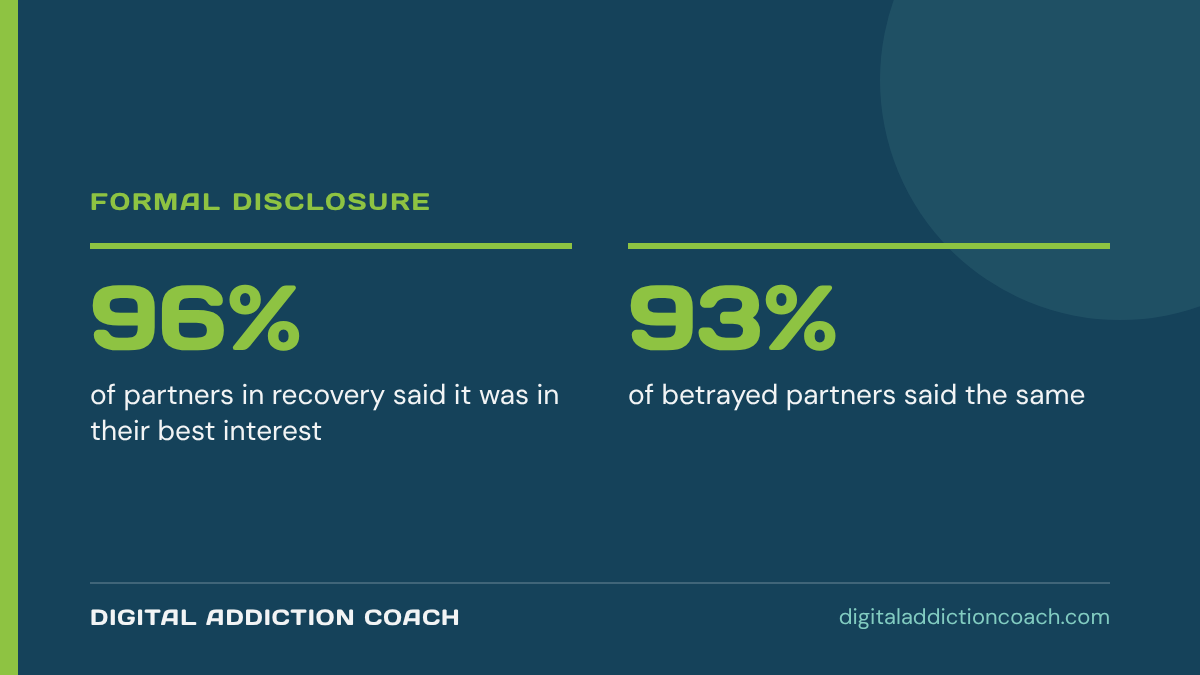
Treatment specialists surveyed couples on both sides of a formal disclosure. 96% of partners in recovery said the process was in their best interest. 93% of betrayed partners said the same. It still hurts to hear the truth. But it gives you something trickle truth never will: an ending. You know you have the full picture, and you can make a real decision from there.
Boundaries Aren't Punishment
Boundaries are the terms you need to stay in the relationship without losing yourself. For example: no devices in the bedroom, open finances, and regular check-ins with a coach that your partner actually shows up to.
A boundary only works if you're willing to enforce it. Not as a threat. As a fact about what you need to feel safe. If it's crossed and nothing changes, it wasn't a boundary. It was a suggestion.
In Part 3, we'll cover why willpower and accountability apps alone rarely hold up, and what real structure for recovery looks like instead.
Ready to Talk Through Disclosure and Boundaries?
If your partner is doing the work, I can help you prepare for a formal disclosure with a therapist who specializes in it. And I'll stay with you through what comes after. Boundaries. Rebuilding. All of it.
Book Your Free Digital Reboot Call
Sources: Fight the New Drug, "Healthy Ways to Support a Partner As They Quit Watching Porn" (2023). Carnes, P., therapeutic disclosure framework, sex addiction treatment research. Restored Life, survey data on therapeutic disclosure outcomes for betrayed and recovering partners. Keffer, S., clinical writing on therapeutic full disclosure practices.


