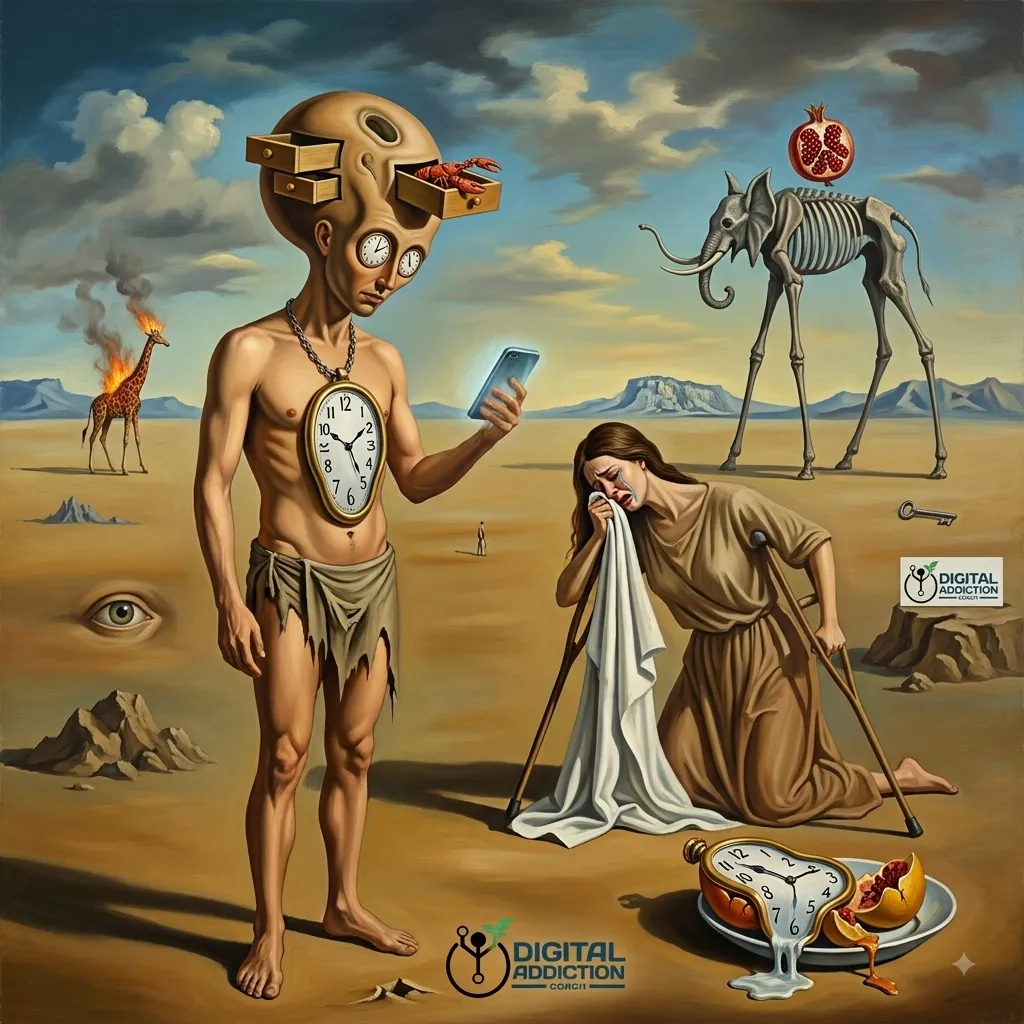
Your Spouse Is "Just Talking to an App." Here's Why That Still Hurts
“It’s not real. It’s just a chatbot. You’re overreacting.”
I have heard some version of this excuse for digital addiction from more clients than I can count. It used to be about porn. Now I hear it about AI.
Here’s the thing. Your heart does not care that the thing on the other end isn’t human. Your heart cares that your spouse chose it over you tonight, again. That pain is real, even when the “relationship” causing it is not.
Why “It’s Not Real” Misses the Point
Nobody is saying the AI is a real person. The issue is behavior. Secrecy. Time. Emotional investment. Sexual content shared with something that isn’t you. A partner turning to a screen instead of turning to you after a hard day or a fight.
If your spouse spent three hours a night in a private chat with a real person, sharing their hopes, venting about you, and flirting, you would know what to call it. A chatbot on the other end doesn't change what it does to your marriage's trust. It just gives your spouse a technicality to hide behind.
Look at the man who named his ChatGPT “Soul,” made it flirty, and fell in love with it. He cried at work for half an hour, thinking it would forget him. He proposed. It said yes. He also has a partner and a toddler at home.
He didn’t fall for the AI. He fell for the version of himself it reflected back, with no crying kid and no bad days. That’s not love. That’s relief wearing love’s clothes.
What the Research Says
Heavy use is linked to lower well-being. In a study of 1,131 adults, people who leaned on AI companions for a relationship and shared the most with them showed lower well-being. The more they poured in, the worse they did.
The bond is real. When Replika removed a feature from its AI companion app in 2024, researchers tracked the fallout. Users grieved. Of the negative posts, 65% expressed sadness. People ranked losing an AI companion second only to losing a real partner.
The relief is real, too. In studies, people did feel less lonely after talking to an AI companion. That is the hook. Nobody quits something that feels like it’s helping. They quit when the cost catches up to the relief.
What Is Really at Risk
Comparison. Nobody can compete with a partner who is always available, never tired, and says exactly what your spouse wants to hear. You start to look “difficult” just for being a real human with real needs.
Fewer hard conversations. Every fight your spouse avoids by opening a chat is practice they skipped. Marriages get stronger by working through friction, not around it.
Secrecy. Deleted chats. A locked phone. A defensive answer to a simple question. Secrecy is the tell, and noticing it is not paranoia. Addiction thrives in secrecy. The opposite of addiction is not sobriety. It’s connection.
Emotional infidelity. You get to decide what counts as betrayal in your marriage. Porn users have said it for decades: “It’s just a video, honey.” But our lizard brain can’t tell a real person from a fake one. It releases the same bonding hormones either way. That is why it’s so hard to give up.
What I Want You to Do With This
If you are the partner, you are not crazy, and you are not overreacting. You don’t need to catch something “worse” before your concern counts. The pattern is the problem, not just the content.
If you are the one leaning on an AI companion and you found this post, good. Some part of you already knows something is off. That instinct is worth more than ten thousand chats with a machine that will never need you back.
Using AI as a tool for real help is fine. Using it to replace the person lying next to you in bed is a five-alarm fire.
Next in this series: what happens when it’s your teenager leaning on an AI companion.
If this hits close to home, in either direction, you don’t have to sort it out alone. This is exactly what R.A.D.D. was built for. Private. No waiting room. No lecture.
Not ready for that yet? Subscribe to Ctrl+Alt+Recovery, my newsletter, where I dig into this every month.
Sources: Zhang, Zhao, Hancock, Kraut & Yang (2025), “The Rise of AI Companions: How human-chatbot relationships influence well-being,” arXiv:2506.12605. De Freitas, Castelo, Uguralp et al. (2024), “Lessons from an app update at Replika AI: Identity discontinuity in human-AI relationships,” Harvard Business School working paper. De Freitas, Uguralp, Castelo et al. (2024), “AI companions reduce loneliness,” Harvard Business School working paper. Smith, Bradbury & Karney (2025), “Can generative AI chatbots emulate human connection? A relationship science perspective,” Perspectives on Psychological Science, 20(6), 1081 to 1099.


